

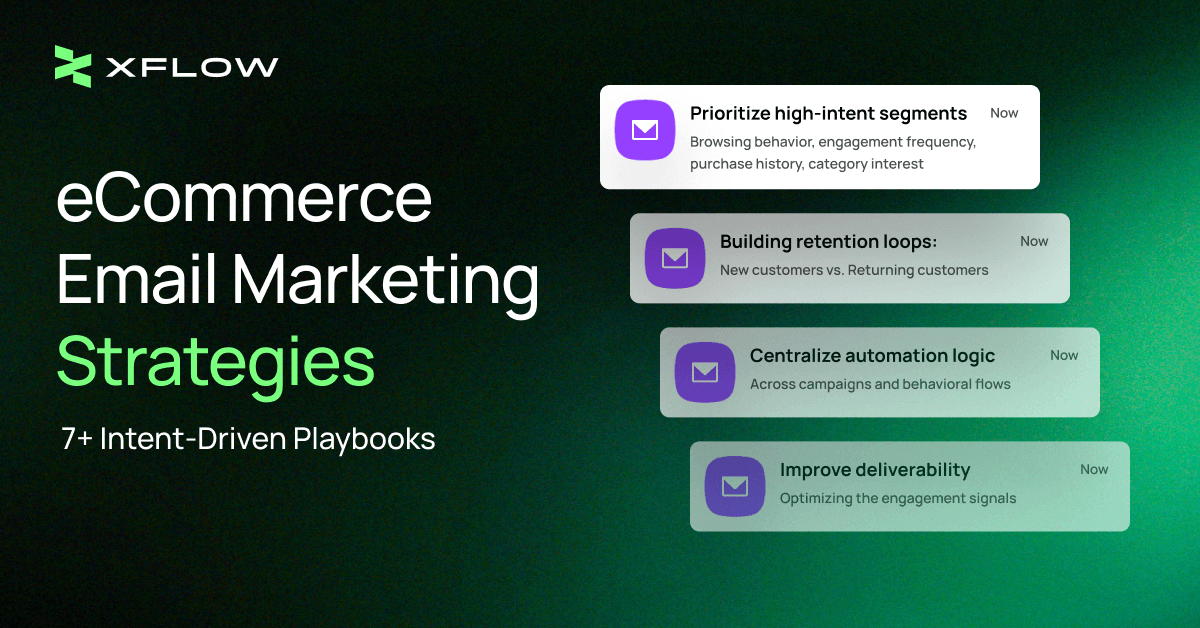
From our implementation, the most effective eCommerce email marketing strategies today consistently focus on three areas:
- Prioritizing high-intent customer segments.
- Building retention loops instead of one-time promotions.
- Centralizing automation logic across campaigns and behavioral flows.
Those systems help eCommerce email campaigns stay behavior-driven instead of purely promotional.
As AI-driven personalization and behavioral automation continue evolving, the future of eCommerce email marketing will depend on how accurately brands respond to customer intent in real time.
For beginners, the biggest priority is to maintain healthy deliverability. If you are still evaluating long-term retention channels, you can also explore whether email marketing is worth it for your current eCommerce growth stage.
Turn Product Demand Into High-Intent Back-in-Stock Revenue
Recover missed sales opportunities with XFlow’s automated back-in-stock flows designed around urgency, VIP access, and seasonal shopping behavior.
Start XFlow for FREEWhat Are The Email Marketing Strategies That Actually Drive Your Performance?
Email marketing is fast-paced, highly visual, and driven by immediate consumer behavior. That makes timing, segmentation, and message intent far more important in email marketing for eCommerce brands.
Shoppers move between browsing, comparing, abandoning, returning, and impulse buying much faster than traditional B2B funnels.
According to Klaviyo’s 2026 benchmark report, here’s what the performance gap across eCommerce email campaigns is:
|
Metric |
All eCom |
High-performers |
|
Conversion rate |
2.3-4.3% |
6-10% |
|
Open rate |
29-35% |
40%+ |
|
CTR |
1.7-2.6% |
4-8% |
|
Revenue per email (RPE) |
$0.32-0.42 |
$0.70+ |
What separates the best eCommerce email marketing from average-performing campaigns is understanding why shoppers engage in the first place.
One practical edge in eCommerce emails is visual clarity: Product imagery, lifestyle images, and in-email visuals can help shoppers move faster from interest to action, especially when the offer is time-sensitive or category-specific.
For example, XFlow's VIP back-in-stock templates create urgency visually rather than relying solely on phrases like "Hurry" or "Limited Stock."
These visual signals help customers instantly recognize product scarcity and popularity, making restock alerts feel more relevant and actionable.

Image source: XFlow
Turn Restock Emails Into VIP Shopping Experiences
Use XFlow's visually rich back-in-stock templates to combine premium product storytelling and lifestyle imagery for faster purchasing decisions.
Try XFlow NOWReal-time intent customer segments
Targeting these segments determines the specific types of emails you should deploy. Because each segment exhibits distinct purchasing behaviors, your prioritization must adapt to real-time intent.
Our tip is to use advanced email automation for eCommerce to personalize your messaging based on core customer intent signals:
- Browsing behavior: What specific products or collections did they view multiple times?
- Engagement frequency: How often do they open, click, or visit your site?
- Purchase history: Are they a first-time buyer or a loyal VIP?
- Category interest: Do they shop exclusively in one product line?
- Seasonal intent: Are they buying specifically during holiday surges or clearance events?
For example, back-in-stock alerts work best when they feel urgent for one segment, elegant for premium shoppers, or warm and thankful for repeat customers.
Some brands use urgency-focused back-in-stock emails with low-stock countdown language. Others use elegant, editorial-style notifications for premium products.

Image source: XFlow
A shopper revisiting a product page three times behaves differently from someone casually opening newsletters every weekend. One is comparison-shopping. The other is still exploring. That distinction changes how eCommerce email marketing should be personalized.
That behavioral difference matters because modern eCommerce email marketing best practices are increasingly tied to emotional buying context.
💡 Insights: Lifestyle brands often perform better with warm, appreciative messaging that feels loyalty-driven instead of sales-driven.
So, where to start your first customer segments?
- Early-stage stores (0–2 years/Low traffic): Prioritize high-intent bottom-funnel signals like cart abandonment and immediate browse abandonment.
💡 With limited traffic, your primary goal is to convert the small stream of high-intent visitors who are already close to the finish line.
- Mature, scaling brands (2+ years): Focus on purchase history and engagement frequency. Use your data to build high-ROI systems like VIP rewards, automated product replenishment, and win-back sequences.
Post-open conversion drivers
Most eCommerce email marketing tips still focus heavily on subject line testing. But subject lines alone rarely explain why one eCommerce email campaign converts significantly better than another.
According to Klaviyo, the average automated email flow placed order rate across all industries is 2.11%, with the top 10% of performers reaching 4.3%.

Image source: Email Marketing Benchmarks 2026 by Klaviyo
From our testing, the modern strategy for eCommerce email marketing is now to test conversion drivers deeper inside the buying journey. That includes:
|
Element |
Priority |
What to test |
The impact |
|
CTA placement |
Fastest |
Test 1 vs 2 CTAs near hero image. |
Fast CTR + quick conversion lift. |
|
Mobile layout structure |
Fast |
Single‑column, stacked cards, fewer sections. Reduce cognitive load on mobile. |
Strong, cross‑campaign lift, especially on mobile. |
|
Social proof placement |
Quick win |
Place 1–2 trust badges (ratings, “X sold”) near the CTA vs buried at the bottom. |
Quick conversion lift. Trust signal at decision point. |
|
Offer positioning |
Tuned win |
Test generic vs behavior‑matched offers (browse vs repeat). |
Strong but needs iteration to optimize size/segment. |
|
Inventory visibility |
Situational fast |
Test vs no indicator (especially for fashion/beauty). |
High‑impact in urgency‑driven categories. Risk of over‑use. |
|
Product image hierarchy |
Medium cycle |
Single large hero image vs grid. Lifestyle vs pure product shot. |
Strong but category‑dependent. |
|
Checkout friction (site‑level) |
High long‑term ROI |
Simplify checkout (fewer fields, guest‑only, auto‑detect) and test email cues that mirror streamlined flow. |
Big lift on completed orders. Slower to test end‑to‑end. |
|
Upsell sequencing |
Long‑term LTV |
Post‑order/post‑session upsell vs in‑cart cross‑sell. |
Stronger average order value and LTV, not instant CTR. |
For example, Allbirds frequently uses single-column email layouts with large product imagery, generous spacing, and one primary CTA. This structure translates well to mobile devices, where most ecommerce email opens now occur.
Key takeaway: Simplified mobile layouts reduce cognitive load and make it easier for subscribers to move from browsing to clicking.

Image source: Allbirds
Traditional tests like send timing and subject lines still matter, especially for larger lists with broad audience behavior. But their impact is becoming smaller compared to the post-open conversion experience.
A fitness supplement brand may see stronger performance by testing replenishment reminder timing based on consumption cycles rather than rewriting subject lines repeatedly.

Image source: Organics Ocean
Meanwhile, bakery brands often improve conversions more through mobile-first visual layouts and pickup urgency messaging than through aggressive promotional copy.

Image source: Levain Bakery
Improve Mobile Conversions with Visual-First Back-In-Stock Flows
Launch mobile-optimized eCommerce email campaigns with stacked visual layouts designed for fast-moving customer decisions.
Explore XFlow NOWRetention loops to new vs. returning customers
First-time buyer campaigns are often treated independently from repeat-purchase strategies, even though long-term profitability depends on how those journeys connect together.
In reality, repeat customers usually generate significantly higher lifetime value because replenishment cycles become predictable, but returning customers also require different messaging logic.
Therefore, your strategic approach to new vs. returning customers must look entirely different:
- New customers: Focus on brand immersion, value realization, educational welcome flows, and establishing community trust.
- Returning customers: Focus on upselling or cross-selling complementary products, predicting restock windows, gathering user-generated content, and offering exclusive VIP rewards.

Image source: KAYAK
However, your revenue attribution shouldn't isolate these two groups. Effective eCommerce email marketing tips demonstrate that acquisition flows and retention loops must stick together.
If your eCommerce store has been running for less than a year, don’t overcomplicate this. You don’t need dozens of complex segments. You just need to build a seamless hand-off from your acquisition flow to your retention loop using these three newbie-friendly tactics:
- The instant welcome-to-customer filter:
The moment a subscriber buys from your Welcome Series, they must be automatically removed from that acquisition flow. If they keep getting "10% off your first order!" emails after they have already bought, it ruins your brand authority.
Do not try to sell them another product yet. Instead, send a warm, founder-led email that validates their purchase, clearly explains when their order will ship, and invites them to follow your social channels.

Image source: BetterBrand
- The "bounce-back" post-purchase offer:
In your automated post-purchase or shipping confirmation email, include a time-sensitive discount (e.g., "Get 15% off your next order in the next 14 days"). This immediately introduces a new customer to the retention loop while your brand is still top-of-mind.

Image source: unfnshed
- The "education first" pivot:
Use your first post-purchase emails to share value. Send a "How to use your product" guide, a styling tip, or a care instructions video. According to Mailchimp, 60% of survey respondents were likely to be repeat buyers after a personalized shopping experience, which includes post‑purchase personalization and follow‑up content.
By educating them, you lower your return rate and build the trust required to secure their second purchase.

Image source: hers
Deliverability improvement with optimized engagement signals
Deliverability improvement means optimizing the engagement signals that mailbox providers use to decide. Even the most sophisticated eCommerce email marketing strategy will fail to generate revenue if your messages never reach the primary inbox.
In eCommerce email marketing, poor deliverability usually shows up as low open rates, sudden spam-folder placement, or repeated unsubscribes.
This becomes especially risky during high-volume retail periods like Black Friday, holiday gifting, or seasonal restocks. eCommerce email campaigns naturally increase during those moments, but inbox competition increases too. High opens, clicks, saves, and reply behavior help reinforce sender trust over time.
For example, XFlow’s restock notification workflow helps improve deliverability by separating customer intent levels. In this workflow, the automation starts only when a product is restocked. The workflow then branches based on customer criteria:
- High-value customers (e.g., customers who spent over a certain amount and are actively opted in) immediately receive a premium follow-up email.
- Other subscribers enter a delayed wait period before additional messaging continues.

Image source: XFlow
XFlow distributes engagement more naturally based on customer value, behavioral intent, and timing sensitivity.
This improves deliverability in several ways, like reducing large-volume send bursts and minimizing subscriber fatigue.
Insights: Mailbox providers interpret these high open-and-click signals as a badge of trust, which organically lifts and guarantees your ongoing domain deliverability.
Join In Any Primary Inbox Placement with XFlow
Maximize your visibility and match your messaging to real-time consumer intent with XFlow's prebuilt, high-deliverability email template library.
Try XFlow NOWConsistent brand communication
Consistent communication does not mean emailing customers every day. It means maintaining reliable engagement patterns that subscribers recognize and expect.
The best eCommerce email marketing best practices usually mix product updates, buying guides, seasonal edits, customer stories, and educational content so the brand stays relevant even when the subscriber is not ready to buy.
From our testing, high-performing email marketing for online retailers usually combines multiple communication types together, such as:
- Educational newsletters.
- Product launches.
- Replenishment reminders.
- Seasonal recommendations
- VIP updates.
- Community-driven content.
- Personalized product suggestions.
Customers become familiar with brand tone, product positioning, and shopping rhythm long before they purchase again.
However, among all these approaches, newsletters now play a much bigger role in email marketing in eCommerce because they give eCommerce email marketing a steady layer between promotional flows.
For example, they help maintain attention between purchase cycles, especially in industries like skincare, fashion, wellness, and lifestyle brands, since they now increasingly use newsletters to build identity-driven engagement.
Here’s how that identity‑driven engagement works in practice:
1. Tone and narrative = brand identity
These newsletters speak like a trusted friend or coach (e.g., “Here’s how to layer your skincare routine,” “What to wear this season, in your style”) rather than a generic catalog.
Over time, that consistent voice associates the brand with a specific lifestyle (e.g., minimalist, confident, self‑care‑driven, elevated everyday style).

Image source: Made In Cookware
2. Curated content as “self‑expression”
Skincare & wellness newsletters often teach ingredient‑level understanding (“Why hyaluronic instead of collagen?”) so the customer feels informed and intentional about their choices.
Fashion newsletters show how‑to style looks (e.g., plies, layering, “capsule” edits) so the reader starts seeing the brand as part of their personal style identity.

Image source: Patagonia
3. Community and “you are here” positioning
Brands spotlight real customers instead of models, featuring “how they wear it” stories and UGC, which makes the reader feel they belong to a tribe defined by values (e.g., self‑care, comfort, slow fashion, inclusivity).
This “community‑centric” framing turns the newsletter into a shared identity space: “People like me shop here, wear this, and treat themselves this way.”
4. Identity‑relevant rhythms
These newsletters follow a pattern tied to the customer’s self‑story:
- Skincare: “Sunday routine refresh,” “Seasonal switch‑over,” “Patch‑test guide.”
- Fashion: “Back‑to‑work edit,” “Weekend‑only looks,” “Capsule wardrobe reset.”
By aligning with the customer’s rhythm of self‑care or style evolution, the brand becomes embedded in their personal narrative, not just the product lifecycle.
In short, identity‑driven newsletters make the brand feel like an extension of the customer’s self‑image (e,g., how they see themselves, how they want to live, how they want to look)
That also affects how brands balance channels between SMS vs email marketing and email vs push notifications. Email remains the strongest channel for maintaining long-form brand familiarity because it supports richer storytelling, product education, and repeat engagement behavior.
Structural email logic across marketing automations
Audience conflicts happen when the same customer gets a welcome series, a browse-abandon flow, a promotion, and a win-back message at nearly the same time.
Standard, basic automations cannot handle cross-flow communication on their own. This creates a structural conflict where separate behavioral triggers fire independently.
But more than that, it matters especially in retail email marketing, where different campaigns can overlap by intent, timing, and product category. From an industry standpoint, strong eCommerce email marketing tips usually focus on centralizing suppression logic, priority rules, and audience exclusions so automations support each other instead of fighting for attention.
So, how do you apply these tips based on your current eCommerce operations?
0–6 months: Centralize suppression logic by “flow family”
At this stage, our advice is to focus on foundational suppression rules:
- Pause promotional campaigns during cart recovery windows.
- Suppress recent purchasers from acquisition offers.
- Limit daily send frequency per subscriber.
- Separate active buyers from passive newsletter readers.
The goal during this stage is to reduce unnecessary message collision while maintaining healthy engagement signals. In other words, allow intent‑driven flows to dominate.
6–24 months: Build automation hierarchy and intent prioritization
At this stage, email marketing for eCommerce brands usually requires priority-based orchestration. That means assigning automation weight based on customer intent level.
So instead of running every automation independently, the section recommends building an automation hierarchy based on customer intent strength:
|
Customer behavior |
Intent level |
Recommended priority |
|
Cart abandonment |
Very high |
Highest |
|
Back-in-stock subscription |
High |
High |
|
VIP loyalty member activity |
Medium-high |
Medium-high |
|
General promotion open |
Medium |
Medium |
|
Newsletter browsing |
Low |
Lowest |
High-intent flows should override lower-priority campaigns automatically. Our advice is to track intent‑based weighting via tags or status fields.
For instance, add a “flow‑state” tag like active_restock, in_cart_abandonment, in_welcome, loyalty_vip_active, etc. It is what separates basic automation from advanced lifecycle orchestration in modern eCommerce email marketing strategies.
Improve Email Flow with XFlow Intent-Based Automation Templates
Prioritize urgent buying signals without creating back-in-stock messages overlap across the customer journey with XFlow.
Start XFlow NOW24+ months: Centralize lifecycle logic across channels
Mature eCommerce brands usually face a different problem entirely: Cross-channel saturation.
For example, during Black Friday, holiday gifting, or viral restocks, almost every automation attempts to increase frequency simultaneously. They usually create temporary seasonal hierarchy rules, such as:
- Cart abandonment overrides newsletters.
- Back-in-stock alerts bypass promotional frequency caps.
- VIP launches suppress public-sale campaigns temporarily.
- Loyalty members receive early-access messaging before mass campaigns begin.
The goal becomes protecting customer attention as a long-term retention asset. This matters because modern eCommerce email marketing best practices increasingly depend on attention management, not just automation quantity.
Optimal campaign launch cycles
The standard campaign cycle usually includes audience selection, offer planning, copywriting, design, QA, scheduling, and performance review. In many stores, the processing used to take around 10 days or more.
Shortening campaign cycles does not mean skipping testing or reducing quality control. It means optimizing workflow speed around:
- Faster creative adaptation.
- Reusable automation structures.
- Dynamic segmentation.
- Modular email layouts.
- Shorter approval chains.
- Real-time inventory integration.
The core of every launch cycle still stays the same: A clear segment, a clear message, and a clear conversion path.
For example, Chewy sends behavior‑triggered replenishment emails for pet food within 24–72 hours based on order history and estimated consumption.

Image source: Chewy
The takeaway is to design your flows as reusable, intent‑based triggers (e.g., cart, browse, replenishment, post‑purchase) so behavior decides when the customer hears from you.
Even the strongest eCommerce email campaigns struggle when every subscriber receives the same message. That is why segmentation has become one of the foundational systems behind high-performing email marketing for eCommerce brands.
How Do I Segment My Email List for Better Performance?
The best eCommerce email marketing strategy starts with segmenting by intent. There are two main ways to segment an email list: Static lists and dynamic segments.
1. Static segmentation: Stable customer grouping
Static segments are fixed audience groups that only change when manually updated or when customers meet very specific criteria. Think of uploaded CSV files from a specific in-person event, a one-off holiday giveaway, or a specific VIP cohort from last year.

Image source: Klaviyo
The advantage of static segmentation is operational clarity. Campaign planning becomes easier because audiences remain relatively stable.
Even though static lists cannot react quickly to changing customer intent, they are not outdated. From an operational standpoint, static segmentation still works extremely well for eCommerce brands.
In fact, many email marketing for eCommerce brands under 10,000–30,000 email profiles still perform efficiently with well-maintained static segmentation. From our testing, VIP customers, seasonal shoppers, and regional subscribers are the best targets for email marketing static lists.
Once you cross ~30,000 to 50,000 profiles, most advanced guides push brands toward hybrid segmentation (static + dynamic/behavior‑based) because intent windows and engagement decay become harder to manage manually.
2. Dynamic segmentation: Real-time behavioral targeting
Dynamic segmentation updates automatically based on customer actions. This is where modern retail email marketing becomes much more intent-driven.
Dynamic email marketing in eCommerce usually segments customers based on:
- By behavior: Behavioral segmentation tracks live shopping activity such as product browsing, cart additions, checkout abandonment, or back-in-stock subscriptions (e.g., Customers repeatedly viewing running shoes may receive targeted athletic collections.
- By lifecycle stage: Lifecycle segmentation organizes subscribers based on where they are in the customer journey, like new subscribers, first-time buyers, returning customers, or VIP shoppers.
- By engagement level: Engagement segmentation tracks how subscribers interact with emails over time. This usually includes open frequency, click behavior, purchase response, or browsing depth.

Image source: XFlow
If the list is still small, start with behavior first because it usually gives the clearest performance lift. From an industry perspective, the highest-converting segmentation strategies today often focus on high-intent customer actions, replenishment timing, and repeat-purchase prediction.
However, even well-structured eCommerce email marketing strategies can underperform when automation logic, timing, or customer intent becomes misaligned.
What Are the 4 Common Drawbacks of eCommerce Email Marketing We Often See?
Even the best eCommerce email marketing best practices break down when messages are too promotional, repetitive, or triggered by the wrong behavior.
High-performing eCommerce email marketing strategies are designed around timing precision, behavioral context, lifecycle relevance, and communication coordination.
When those elements become misaligned, even technically “optimized” eCommerce email campaigns can reduce engagement over time.
1. Discount-only email message
A discount-only email message is a common failure in email marketing for eCommerce, especially when a store uses the same “10% off” angle for every campaign.
It works best when the customer already shows high purchase intent or when you need to move a specific inventory problem fast. In practice, that means it performs well for cart abandoners, price-sensitive shoppers, seasonal clearance, or short-lived promos where urgency matters more than education.
For example, fashion eCommerce brands often experience “promotion dependency” during heavy seasonal cycles. Customers are repeatedly exposed to weekend flash sales, mid-season markdowns, or influencer discount codes.

Image source: MeUndies
So, when to combine a discount with other email messages? Our advice is that when the audience needs more context to decide. First send a value or reminder email, then a product-focused email, then a discount if engagement stays high but purchase does not happen.
Pro tip: If the customer is ready to buy, lead with the offer; if the customer is still deciding, lead with value and attach the offer later.
2. Repetitive timing
Repetitive timing happens when eCommerce email campaigns arrive on the same day, at the same hour, with the same cadence every week.
For example, an online retailer that sends every promo on Friday morning, then wonders why open rates flatten out.
According to Mailchimp, Tuesday through Thursday, especially around 9–11 AM or early afternoon, tend to perform well for promotional campaigns because people are settled into the work week and checking inboxes during predictable breaks.
Friday can also work, but mostly when the message matches weekend shopping intent, such as flash sales or last-chance offers.
What is behind this behavior is that higher-engagement audiences can handle more frequent sends, while colder audiences need more spacing and more relevant timing:
- Morning sends often work for planning and workday inbox checks, while
- Afternoon sends can catch people after lunch or during a lower-focus window;
- Weekend sends are usually weaker overall, but can still work for consumer shopping or hobby-driven categories.
Insights: Welcome emails should go out immediately after signup, and abandoned cart emails typically work best 1 to 4 hours after abandonment. Re-engagement emails are different. They tend to perform better mid-week during normal business hours.
3. Abundant email campaign stacks
Use a campaign that aligns with an existing flow when the customer is already showing the same intent the flow was built for.
So, when should campaigns align with active flows?
Campaigns perform best when they reinforce the same behavioral direction already happening inside the customer journey:
|
Active flow |
Best supporting campaign |
Why it works |
|
Cart abandonment |
Low-stock reminder or social proof campaign |
Reinforces purchase urgency already present |
|
Back-in-stock flow |
Seasonal trend launch or “customers also bought” campaign |
Expands active buying momentum |
|
Replenishment flow |
Routine-building content or subscription offer |
Supports repeat-purchase behavior |
|
VIP early-access flow |
Loyalty campaign or private collection preview |
Reinforces exclusivity identity |
|
Browse abandonment |
Educational or comparison-focused campaign |
Helps decision-stage shoppers reduce hesitation |
According to Klaviyo, the supporting email campaign acts as reinforcement, adding urgency, trust, education, or exclusivity at the exact stage where the shopper needs it most.
This is why many high-performing ecommerce brands coordinate campaigns around active automations.
The best-performing eCommerce brands use campaigns to amplify active customer intent already happening inside automations. The easiest way to think about this is:
- Flows react to behavior.
- Campaigns amplify momentum.
To decide the priority of which to run first, our tip is to start by ranking messages by purchase intent, timing sensitivity, and customer relationship stage.
Cart recovery is usually highest because it follows an active buying action, while newsletters are a lower priority because they are informational and broader in purpose.
Post-purchase messages support onboarding, usage, or replenishment.
4. Misaligned behavioral triggers
Implementing advanced email automation for eCommerce is incredibly effective, but only if your data syncing is flawless.
The problem usually starts when automation triggers rely on activity volume without understanding buying intent. From our testing, for beginners, the most reliable buying‑intent indicators to focus on are:
|
Buying intent |
How it shows up in behavior |
Best behavioral flows |
|
“I’m ready to buy now” |
Added to cart, viewed cart page, started checkout (entered billing/shipping). |
Cart abandonment, checkout recovery, and payment support flows. |
|
“I’m actively considering this product” |
Viewed the same product page multiple times in one session or 24 hours. |
Browse‑abandonment, FAQ/reassurance, size‑fit or “how‑to‑use” nurture emails. |
|
“I just bought (now let’s secure the next one).” |
Completed first purchase, completed replenishment‑style purchase (e.g., skincare, supplements, consumables). |
Post‑purchase nurture, care instructions, restock/re‑order reminders. |
|
“I’m not buying now, but I’m interested” |
|
Light nurture, editorial/educational content, win‑back. |
Once triggers are tied to these intent‑based behaviors, your flows start matching what the customer is actually doing, not just how much they’re browsing.
As eCommerce email marketing becomes more behavior-driven, AI is increasingly helping brands execute faster, personalize deeper, and optimize customer timing more accurately across the entire lifecycle journey.
How Does AI Impact Email Marketing Performance?
AI now influences almost every step of an eCommerce email workflow, from audience selection and timing to copy generation and post-send optimization.
But here’s the important distinction: not every AI feature improves performance equally. In practice, the most effective AI-driven eCommerce email marketing strategies usually focus on:
- Behavioral personalization.
- Lifecycle orchestration.
- Intent prediction.
Those directly affect conversion timing and customer relevance, which ultimately drive revenue performance more than surface-level automation alone.
AI-powered personalization
AI-powered personalization works by using customer data to tailor offers, product picks, and messaging to each shopper’s behavior. This modern eCommerce email marketing strategy goes vastly beyond simply merging a subscriber's first name into a text field.
If two subscribers open the exact same email at the exact same time, they will see completely different merchandise grids tailored precisely to their current purchasing desires.
From an operational standpoint, AI personalization is currently one of the highest-impact improvements in eCommerce email marketing because it directly affects:
- Click-through relevance.
- Repeat engagement.
- Conversion consistency.
As eCommerce competition becomes more behavior-driven, the future of retail email marketing depends more on how intelligently each message adapts to customer journeys.
Predictive send time optimization
Traditional retail email marketing relies on broad geographic time zones to schedule broadcasts (e.g., "Send at 10:00 AM EST").
Predictive or scheduled send controls can determine what percentage of recipients receive the campaign at each time window, allowing brands to pace delivery. In practice, instead of sending the full list at once, you can stagger delivery by recipient percentage over time.
For eCommerce, a good starting point is usually 10% to 20% per hour for larger lists, because it reduces delivery spikes and gives you room to monitor performance early. If the campaign is time-sensitive, use a higher rate.

Image source: XFlow
AI-generated subject lines & drafts
AI can speed up subject-line and email-copy production by assembling messaging from approved content blocks, audience context, and campaign goals. The advantage is speed, but the risk is generic or off-brand copy if the prompt is weak or the data is messy.
So, based on our implementation, here are tips for beginners using AI-generated email content:
- Start with one email goal only
- Decide your brand tones
- Use AI for modular sections like CTA sections, hooks, product storytelling, FAQ blocks, or social proof sections.
And remember, the better approach is treating AI like a structured campaign assistant instead of a one-click email writer.
Smart segmentation
Smart segmentation utilizes predictive modeling to group your audience based on future intent. For example, enabling Smart Sending in platforms like Klaviyo means profiles that have already received another campaign email within the past 16 hours may automatically be skipped.

The bigger issue in email marketing for eCommerce brands is not usually “sending too little.” It is overloading high-activity customers during overlapping campaigns and automations.
However, what happens to customers skipped during those 16 hours? And how to avoid losing conversions during smart-send suppression?
Our tip is to send a lighter secondary version of the campaign 48 - 72 hours later to recently engaged non-openers to boost engagement with a softer subject line, reduced urgency, or more personalized product context. Repeating aggressive urgency often creates fatigue instead of increasing conversions.
If you want to protect your store and avoid the most common operational pitfalls, remember this single key rule: Master one high-intent behavioral flow before you touch anything else.
Do not worry about building predictive lifecycle loops or complex multi-tier VIP segments in your first month. Just ensure your instant customer suppression filters are active, and your deliverability baseline is clean.
Modern retail email marketing is no longer just about sending more campaigns. It is about delivering the right message at the right behavioral moment. Explore more eCommerce marketing insights on the XFlow blog.
FAQs About eCommerce Email Marketing Strategy
How do I improve eCommerce email conversion rates?
Start with improving behavioral relevance instead of simply increasing send volume.
Our tip is to focus on:
- High-intent segmentation.
- Lifecycle-based messaging
- Timing optimization.
- Stronger automation coordination.
For early-stage stores, our advice is to focus almost exclusively on bottom-funnel triggers like cart and browse abandonment to capture ready-to-buy traffic.
Do I need discounts in every email campaign?
No, relying on discount-only email messages is a dangerous drawback that devalues your brand equity and your profit margins.
Instead, build a sustainable opening habit by alternating your promotional offers with value-driven content by:
Using educational product guides, founder-led brand narratives, and user-generated content (UGC) spotlights.
Our tip is to save your discounts for strategic, automated milestones, such as a time-sensitive "bounce-back" offer in a post-purchase loop or a precise win-back trigger for a lapsed customer.
What’s the difference between browser abandonment and cart abandonment emails?
The core difference comes down to the velocity of customer intent:
- Cart abandonment: This is a high-intent, bottom-funnel signal. The customer actively added an item to their cart but tripped at the finish line.
👉 These emails should be highly direct, urgent, and focused on clearing friction to secure the sale.
- Browse abandonment: This is a mid-funnel signal. The customer viewed a product or a targeted collection multiple times but didn't click "add to cart."
👉 Because their intent is softer, your browse abandonment emails should feature alternative styles within that collection, helpful FAQs, and social proof to build consideration.
What role do behavioral triggers play in future email strategies?
Behavioral triggers are the foundation of future email automation for eCommerce. In future strategies, triggers will coordinate using strict centralized logic.
For example, you will deploy a single broadcast, and an automated behavioral flow will automatically handle the follow-ups only for the specific subscribers who opened but didn't buy.
They ensure your brand remains hyper-reactive to customer actions and your email marketing predicts the right customer intent.
How can I improve my click-through rate so more people check out my products?
Improving click-through rate usually depends more on message relevance. To get more subscribers moving from their inbox to your checkout page, implement these three tactical adjustments:
- Dynamic personalization: Use smart segmentation to display product grids aligned with what the subscriber actually looks at.
- Geographic layering: Use location filters to match real-time seasonal demand. Tailor your collection blocks by region.
- Urgency and tone matching: Utilize delivery frameworks (like XFlow’s template library) during high-velocity events like flash sales or trend-driven demand spikes.
And remember to align your messages with behavioral intent to ensure higher click-through rates.
