

More traffic, higher conversion rates, bigger orders. All can help grow ecommerce sales. But not every strategy is right for your store, and using the wrong one can hurt your profits.
For example, offering free shipping to increase order value may backfire if the extra sales don't cover shipping costs. Similarly, running ads for low-margin products can generate orders while leaving little profit after advertising expenses.
Knowing how to increase ecommerce sales is essential but understanding which strategies fit your store, when they're worth using, and how to make them work effectively is what drives results
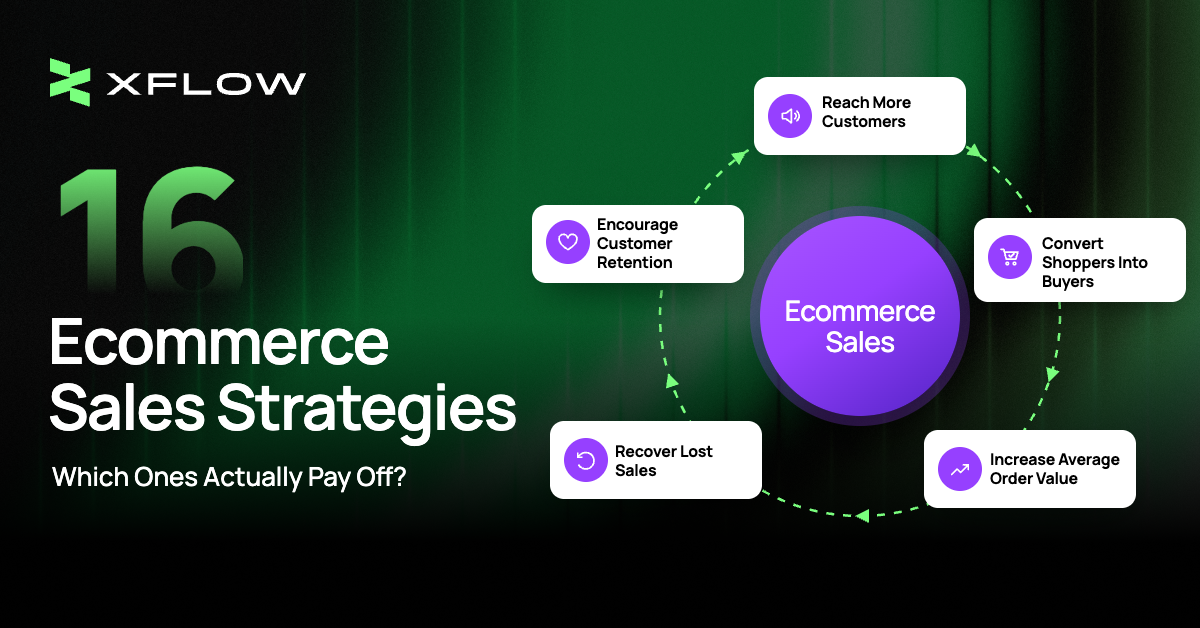
In this guide, we'll explore 16 practical ecommerce sales strategies across five areas of revenue growth:
- Customer acquisition: Attract shoppers who are likely to buy.
- Sales conversion: Turn interested visitors into customers.
- Average order value: Increase how much customers spend per order.
- Sales recovery: Recover missed purchases and out-of-stock demand.
- Customer retention: Encourage existing customers to buy again.
Each strategy goes beyond basic tactics, with practical examples, key considerations to help you decide whether it's right for your store, apply it effectively, and grow sales profitably.
Optimize These 4 Sales-Driven Channels: Advertising, AI Shopping, Social Commerce, and Affiliates
1. Reach High-Intent Buyers With Product-Focused Advertising
Product-focused advertising helps merchants put relevant products in front of potential buyers. But the right ad format depends on how customers discover and evaluate products.
For example, Google Shopping displays products to shoppers actively searching for them.

Nike uses Meta catalog carousel ads to showcase different shoe styles, while True Classic uses TikTok videos to demonstrate how its shirts fit.

Image source: Nike
Confect's 2026 analysis of Nike's Meta ads found that Catalog Ads made up just 26% of its active ads but accounted for 75% of daily ad spend.
This shows why ad formats deserve separate evaluation. Test how different formats perform, then allocate more budget to those generating worthwhile purchases rather than simply producing more ads.
However, high-intent searches can attract strong competition and higher cost-per-click (CPC). For low-priced or low-margin products, acquisition costs may consume most of the profit from an order.
To manage this:
- Target more specific searches. Instead of competing only for broad keywords like "running shoes," test relevant searches such as "waterproof trail running shoes for women" to reach shoppers with clearer needs. These searches aren't necessarily cheaper, so compare actual costs and conversion performance.
- Prioritize products with better acquisition economics. Promote products with sufficient contribution margins or relevant product sets that can support the cost of acquiring an order.
- Reallocate budget based on results. Reduce spending on products or targeting combinations that consistently fail to generate worthwhile orders, and invest more in those that do.
Measure conversion rate, customer acquisition cost (CAC), and contribution margin after advertising to identify which products, platforms, and ad formats deserve more budget.
2. Make Your Products Discoverable and Worth Recommending for AI Models
Product discovery was then on search engines and marketplaces, and now in AI chatboxes.
That means customers can now ask AI assistants to recommend products based on their needs and compare available options before making a purchase.
For example, you enter into your ChatGPT chatbox:
"Can you recommend a lightweight moisturizer for sensitive skin under $40?"

Instead of searching through multiple online stores, the shopper may receive relevant product recommendations directly within the AI experience.
For Shopify merchants, Agentic Storefronts provides a way for eligible products to become discoverable across AI shopping channels, including ChatGPT, Google AI Mode and Gemini, and Microsoft Copilot.

However, the purchasing experience differs by channel.
ChatGPT currently acts as a product discovery and referral channel, with customers completing purchases through the merchant's online store checkout. Other supported AI channels may offer Shopify-powered direct checkout when available and enabled.
To prepare your products for AI-assisted shopping:
- Keep product titles and descriptions specific, accurate, and easy to understand.
- Maintain complete product attributes, images, pricing, and inventory information.
- Publish clear shipping, return, and refund policies.
- Review channel eligibility and settings in Shopify's Sales channels > Agentic section.
- Monitor AI-channel referrals, product discovery, and attributed sales where reporting is available.

Image source: Stylevana
Clear product information matters because AI shopping experiences need to understand what you sell and which customer needs your products address.
However, product eligibility doesn't guarantee that an AI assistant will recommend a particular item.
The opportunity is to make your products available where customers are increasingly discovering buying options, while treating AI channels as another measurable sales source.
3. Social Commerce: Match the Selling Channel to How Customers Buy
Social commerce isn't simply about posting more product content. It's about choosing a selling environment where customers can discover, evaluate, and purchase products.
The right approach depends on how your customers prefer to shop socially.
Shoppable content: Platforms such as Instagram, Facebook, and TikTok support different combinations of product tagging, shopping catalogs, and purchasing features, depending on location and eligibility.

Image source: PinkTag
For example, a fashion brand PinkTag can tag products in a social post so interested viewers can find the exact items shown. This reduces the effort of searching for products after discovering them.
- Live shopping: Particularly useful for products that benefit from demonstrations. A beauty merchant can show how a product works, answer questions, and direct viewers to purchase while interest is high.
- Private buying groups: Facebook Groups and similar communities can support a more conversational sales approach. Members may ask for recommendations, compare options, and purchase through shared product links or direct arrangements.
This approach depends on an active community and clear selling rules. Private groups don't necessarily provide built-in checkout or the same buyer protections as established commerce channels, so merchants should use secure payment and ordering processes.
Rather than trying every social platform, choose based on how the product is sold:
|
Selling approach |
Best suited to |
|
Shoppable posts and videos |
Visual products that attract interest through content |
|
Live shopping |
Products that benefit from demonstrations and real-time questions |
|
Private buying groups |
Niche audiences where discussions, recommendations, and recurring product interest support purchases |
Keep the buying process simple, regardless of channel.
Track product clicks, attributed orders, and sales value—not just views or engagement. If people engage but don't purchase, investigate whether the problem is product relevance, unclear buying instructions, or friction after leaving the platform.
4. Affiliate and Creator Partnerships: Why Audience Fit Matters More Than Reach
Affiliate and creator partnerships let merchants reach potential buyers through people they already follow or trust.
But a creator's ability to attract attention isn't necessarily the same as their ability to generate purchases.
Consider a skincare brand promoting a moisturizer. A lifestyle creator with a broad audience might generate substantial reach. A smaller skincare creator who regularly discusses skin concerns and demonstrates routines may attract fewer viewers but a more relevant group of potential buyers.
The strongest partnership isn't always the one with the most reach. It's the one that connects the product with an audience that has a reason to buy it.
Before choosing a partner, evaluate three things:
- Audience fit: Does the creator regularly reach people interested in this product category?
- Selling approach: Can they explain or demonstrate the product's benefits in a credible way?
- Campaign economics: Can the expected sales support commissions, creator fees, discounts, and product costs?
Then establish a clear selling arrangement:
- Provide accurate product details and demonstration guidance.
- Offer trackable affiliate links or discount codes.
- Set commission terms based on your margins.
- Review attributed orders, returns, and acquisition costs.
- Follow applicable advertising disclosure requirements.

Image source: ClickUp's Affiliate Program
Start with a small, relevant group of partners and compare results before scaling.
If a campaign attracts clicks but few orders, investigate whether the audience, product presentation, offer, or landing page needs improvement. Don't automatically assume the solution is a bigger discount or a more expensive creator.
Turn Product Interest into Purchase: What Makes Shoppers Buy?
5. Encourage Purchases With Targeted Offers
Offering the same discount to every visitor is easy, but it can waste margin.
Not every shopper needs the same incentive.
- A first-time customer might appreciate a welcome offer.
- Someone who has repeatedly viewed a particular product category may respond better to a product-specific promotion.
- An existing customer may value exclusive access to a new collection
Consider three common cases:
|
Customer situation |
Possible offer |
|
First-time buyer |
Welcome discount or first-order gift |
|
Interested in a specific category |
Relevant category promotion |
|
Existing customer considering another purchase |
Exclusive product or member offer |
Don't assume repeated product views mean someone is waiting for a lower price. They may be comparing products or checking details before purchasing.
Use customer behavior to form a hypothesis, then test a suitable incentive rather than discounting automatically.
Measure completed orders and profit after incentive costs. Where possible, compare similar groups with and without an offer to estimate whether it created additional purchases.
6. Limited-Time Promotions Work Best With a Clear Selling Goal
Limited-time promotions give interested shoppers a reason to buy sooner. Flash sales, seasonal discounts, and limited releases can all create urgency, but they don't serve the same business goal.
The question isn't simply how to create urgency. It's what the deadline should help your store achieve.
|
Promotion type |
Main goal |
Example |
|
Flash sale |
Generate purchases within a short window |
24-hour offer on selected products |
|
Seasonal clearance |
Move aging inventory |
Weekend sale before a new collection arrives |
|
Limited release |
Capture demand for restricted availability |
Exclusive product drop with a defined purchase window |
For example,
- A fashion brand may reasonably discount last season's inventory before introducing new styles. But repeatedly discounting a bestseller that already sells at full price may reduce margins without generating much new demand.
- A homeware brand might offer special pricing on selected products for a weekend. A fashion store might launch an end-of-season promotion with a clearly stated end date.

Source: hotfootshoes
To make urgency useful rather than distracting:
- Choose products that have a clear reason to be promoted.
- Set a genuine promotion period or availability limit.
- Make the offer conditions easy to understand.
- Communicate the deadline consistently across the store.
- Check discount combinations and profit margins before launch.
Countdown timers and promotional banners can help communicate an actual deadline, but they shouldn't create artificial scarcity.
There's also a difference between targeted offers and limited-time promotions.
- Targeted offers answer "Who should receive this incentive?"
- Limited-time promotions answer "Why should someone buy now?"
You can combine both approaches, but each should serve a clear purpose.
Before launching, define the desired outcome: more orders, faster inventory turnover, or demand for a limited release. Keep deadlines and offer conditions clear, and avoid artificial scarcity.
Then measure more than the campaign's sales spike. Check margin, remaining inventory, and sales after the promotion ends.
A good limited-time promotion should achieve a business goal, not just move next week's orders into this week.
7. The Right Product Proof Can Resolve the Doubts Reviews Can't
Not every shopper who leaves without purchasing needs a discount. Some simply aren't confident enough to buy.
They may be wondering:
Will this fit? Is it worth the price? How does it compare with another option? What happens if it doesn't work for me?
These are sales objections, even when there's no salesperson involved.
Your product pages should help customers resolve them.
- For apparel, accurate sizing information and customer fit reviews may be more persuasive than a generic trust badge.
- For skincare, shoppers may need clear ingredient information, usage guidance, and explanations of who the product is suitable for.
- For electronics, compatibility details, specifications, and side-by-side comparisons can help customers choose confidently.
Research from Northwestern University's Spiegel Research Center found that products with five reviews had a 270% higher purchase likelihood than products with none. The same research also found that the additional benefit of collecting more reviews diminished after the first few.

Source: Manitobah
That raises a practical question: Once shoppers trust the product, what evidence will help them decide it's right for them?
Consider a customer buying boots. A five-star rating establishes confidence, but it doesn't necessarily answer whether the boots fit wide feet.
Useful sales evidence includes:
- Verified customer reviews that address common concerns.
- Customer photos and product demonstrations.
- Clear product specifications and comparisons.
- Transparent shipping and return information.
- Relevant guarantees and warranty details.
The key is to connect each piece of information to a real purchase concern.
A row of five-star reviews may support credibility, but it won't necessarily answer whether a jacket fits someone between two sizes.
Focus on the questions customers need answered before clicking Add to Cart.
8. Turn Buying Questions Into Decisions With Live Chat and A
A customer may need help choosing between two sizes, checking whether an accessory fits an existing product, or deciding which product is most suitable for a particular need.
This is where real-time sales assistance becomes useful.
Effective live chat strategies to boost ecommerce sales focus on helping shoppers make decisions, rather than simply providing a support contact.
For example, a customer shopping for a camera might ask:
"Which lens should I choose for indoor photography?"
A helpful live chat agent can clarify their needs, explain suitable options, and direct them toward relevant products.
AI shopping assistants can handle common product questions when they're connected to reliable product information, while human agents can step in for more complex requests.

Image source: Delight.ai AI Chatbot
There's another opportunity in those conversations: use repeated questions to improve how products are sold.
If customers consistently ask which two models to choose, a comparison guide may help future shoppers decide without opening chat.
Measure assisted purchases and recurring questions, but don't attribute every chat-assisted order entirely to the conversation.
The goal isn't more chats. It's helping customers reach the right purchase decision with less uncertainty.
Get More Value per Order: Upsells, Bundles, and Purchase Incentives
9. Upsell Customers to Higher-Value Products
Your Shopify average order value tells you how much customers spend per transaction. Increasing it can help you earn more from existing orders, but the right approach depends on what customers naturally buy together and whether additional incentives leave enough profit.
Upselling encourages customers to choose a higher-value version of something they're already considering.
That might mean better materials, additional functionality, larger capacity, or a useful customization.
For example, luggage brand Away offers paid personalization options for selected suitcases with an additional $10 to $50. Shoppers can choose from different text styles and colors to make their luggage feel more personal.

Image source: Away
With product like a luggage the customer doesn't need another suitcase. They can make the original purchase more personal.
This illustrates an important principle: show the additional value before asking customers to spend more.
For a true product upgrade, compare the features that justify the higher price. For a paid customization, show a preview and explain exactly what the customer receives.
Timing also matters. Introduce upgrades while customers are still selecting their main product. An expensive alternative introduced after they've already decided may force them to reconsider the purchase.
Start with upgrades closely related to the original need and budget.
Track upgrade acceptance, AOV, and profit per order. If a recommendation increases spending but regularly causes shoppers to abandon their purchase, it may be creating more friction than value.
10. Increase Basket Size With Cross-Selling and Product Bundles
Cross-selling recommends complementary items, while bundling combines related products into one purchasing offer. Both can increase AOV, but they're not always equally suitable.
For example, Murad's sales strategy with skincare products. Instead of buying individual items, they could choose the Sleep Tight 2-Piece Holiday Set, which combines complementary products at a 25% discount. This creates an opportunity to increase order value while giving customers better value through a complete skincare routine.

Image source: Murad
The decision comes down to whether the products naturally belong together in the customer's purchase.
If customers frequently buy the same items together, a bundle could simplify the decision.
But if most shoppers would already buy both products at full price, adding a bundle discount could reduce margin unnecessarily.
If an accessory is useful only to some customers, a separate product recommendation may be more appropriate.
Try these placements based on the purchase:
- Product pages for relevant complements.
- Frequently bought together sections for common combinations.
- Cart add-ons for optional accessories.
- Curated bundles for complete routines or product sets.
Before bundling, review commonly purchased combinations, product margins, and whether the combined offer adds convenience or meaningful value.
Track attachment rates, bundle purchases, AOV, and profit per order. The strongest recommendation makes the original purchase more useful—not just more expensive.
11. Encourage Larger Purchases With Spending and Quantity Incentives
Spending and quantity incentives encourage customers to buy more by rewarding them for reaching a minimum order value or purchasing multiple units.
Spending thresholds increase cart value. For example, if your store's AOV is $55, you could offer free shipping on orders of $70 or more. A customer with $58 in their cart sees "You're $12 away from free shipping," giving them a reason to add another product.
Free shipping incentives are especially effective when shoppers are close to the threshold and can easily add a low-cost, useful item to qualify.

Image source: FoxKit
Quantity discounts encourage customers to buy more units. For example, a skincare brand could offer:
- Buy 1 moisturizer for $25
- Buy 2 for $45 (save $5)
- Buy 3 for $60 (save $15)
Volume discounts work best for products customers use regularly or buy in multiples, such as skincare, coffee, grocery supplies, and everyday essentials. They're less suitable for expensive, one-time purchases.

Image source: Amazon
For Shopify merchants, FoxKit can help display free shipping goals and volume discount offers during shopping.
But higher AOV doesn't automatically mean higher profit.
A customer who adds a $15 product to qualify for free shipping may increase order revenue. Whether that helps profitability depends on the additional product's margin and the shipping cost your store now absorbs.
Set thresholds using your existing order values, shipping costs, and margins—not an arbitrary amount above current AOV.
For quantity discounts, check whether the added units generate enough contribution to justify the discount across the order.
Choose the incentive that fits what customers naturally buy, then measure both order value and profit after incentives.
Sell Even When You Are Out-of-Stock: Abandoned Carts, Checkouts, and Restocks Matter
12. Recover Abandoned Carts and Checkouts With Timely Follow-Ups
A shopper adds a product to their cart, starts checkout, then leaves without ordering.
What should happen next?
First, distinguish between browsing, cart, and checkout abandonment.
Someone who viewed a product may only be exploring options. A shopper who started checkout has shown stronger purchase intent.
Recovery messages should reflect that difference.

Image source: Really Good Email
For eligible customers, abandoned checkout reminders can include the products left behind and a direct link back to checkout.
Depending on consent, channel capabilities, and available customer information, merchants can use email, SMS, or relevant retargeting.
A practical recovery sequence might look like this:
|
Follow-up |
Purpose |
|
First reminder |
Show the abandoned items and link back to checkout |
|
Second reminder |
Address relevant concerns about delivery, returns, or suitability |
|
Optional incentive |
Test a benefit when there's a credible price-related barrier |
Automation makes these follow-ups easier to manage.
Among practical ecommerce automation sales boost strategies, abandoned checkout workflows are especially useful because they respond to an identifiable customer action.
They can also form part of broader email marketing strategies for ecommerce sales, alongside post-purchase and retention campaigns.
However, recovery emails shouldn't replace fixing the underlying shopping experience.
If many customers consistently leave when shipping costs appear, make delivery charges clearer earlier in the journey. Don't assume another coupon will solve that issue.
- Match reminder timing and frequency to purchase behavior, consent, and available channels.
- Track recovered orders, attributed revenue, unsubscribes, and incentive costs.
A purchase made after an email isn't automatically proof that the email created an additional sale.
13. Turn Stockout Demand Into Orders With Restock Alerts and Preorders
A popular product selling out can be a positive demand signal.
But it also creates a problem: customers who want to purchase can't complete their orders.
If those customers leave without expressing their interest, you may lose an opportunity to bring them back.
Back-in-stock alerts help preserve that demand. Instead of showing only a "Sold Out" label, offer shoppers a way to request a notification when the product becomes available again.

Image source: XFlow demo
You can also set up automated workflows with tools like XFlow to send restock notifications as soon as inventory becomes available, without having to follow up with customers manually.

Image source: XFlow workflow template
The time it takes to restock matters. The longer a product remains unavailable, the greater the risk of customers losing interest or buying from competitors, especially when similar alternatives are easy to find. Prioritize faster replenishment for high-demand products, using restock subscriptions to identify which products, sizes, or variants customers are waiting for.
Preorders take a different approach: secure purchases before products become available. They're particularly useful for:
- Made-to-order products: Accept orders before production, reducing the need to hold excess inventory.
- Higher-value items: Gauge committed demand before investing heavily in inventory, particularly when deposits or advance payments are supported.
- Limited drops and upcoming launches: Let interested customers reserve products ahead of release, helping capture demand while anticipation is high.

Image source: Amazon
Preorders reduce the waiting period before placing an order, but customers still have to wait for delivery. Clear shipping estimates, payment terms, and regular updates are essential to maintaining purchase confidence.
The key difference: Restock alerts bring customers back when inventory returns, while preorders let them commit to buying before it arrives. Both help preserve sales opportunities that would otherwise be lost to stockouts.
Aim for Retention: Loyalty Programs, Subscriptions and Win-back Campaigns
14. Loyalty Programs: Give Customers More Reasons to Stay
Understanding how to increase repeat purchases starts with why customers would return. Some need a reason to stay loyal, others need to replenish products, while inactive customers may need a relevant reason to reconnect. Each buying behavior calls for a different approach.
An loyalty programs encourage repeat purchases by giving customers rewards and benefits that grow as they continue shopping with your brand.
Common incentives include loyalty points, purchase-based rewards, exclusive offers, and VIP tiers. But effective loyalty programs go beyond discounts. They give customers a reason to keep coming back and build a stronger connection with the brand.
A good example is Sephora Beauty Insider, a tiered loyalty program where customers unlock greater benefits as their annual spending increases.

This changes the motivation from simply earning discounts to unlocking access and recognition. Customers have more reasons to stay engaged with the brand and maintain or advance their membership status.
For your Shopify store, consider rewards that match what your customers value:
- Points and discounts: Encourage repeat purchases with rewards customers can redeem.
- Exclusive access: Offer early shopping opportunities for new collections or limited releases.
- VIP tiers: Unlock increasingly valuable benefits as customers reach spending milestones.
Keep the program simple, with clear requirements and benefits for each tier.
Most importantly, measure repeat purchase rate, purchase frequency, and reward costs. A successful loyalty program should encourage additional profitable purchases, not simply discount orders customers would have placed anyway.
15. Encourage Recurring Purchases With Replenishment and Subscriptions
Some ecommerce products have predictable consumption cycles. Coffee runs out. Skincare products get used up. Pet supplies need replacing. These products create opportunities to make repeat purchasing more convenient.
Replenishment reminders encourage customers to reorder when they're likely to run low. For example, a skincare brand can send a reminder six weeks after purchase if that's the product's typical usage cycle. Customers still decide when to place their next order.
Subscriptions go further by turning one-time purchases into recurring orders or payments. Depending on the products and customer needs, merchants can offer three common models:
- Replenishment (Subscribe & Save): Automatically reorder everyday consumables at a small discount, typically every month. Ideal for coffee, supplements, pet food, and skincare refills that customers need regularly.
- Curation (Subscription Boxes): Deliver a rotating selection of products, such as healthy snack boxes, seasonal fruit boxes, or weekly healthy meal plans with changing menus. Customers pay for convenience, variety, and curated selections.
- Access (Membership): Charge a recurring fee for exclusive products, member-only pricing, or special benefits.
A good example is Chewy’s Autoship program. Pet owners can schedule recurring deliveries of essentials like dog food, cat litter, and eligible pet medications at their preferred intervals, with automatic payments. This saves customers from repeatedly placing the same orders while helping Chewy generate recurring sales.

For merchants, subscriptions create more predictable recurring revenue and can increase customer lifetime value. For customers, they simplify repeat purchasing or provide ongoing value through new selections and exclusive benefits.
The right approach depends on purchasing behavior. Use replenishment reminders when customers prefer to reorder on their own schedule. Offer subscriptions when recurring convenience, product discovery, or exclusive access gives them a reason to commit.
Whichever model you choose, keep delivery schedules, recurring charges, and cancellation terms clear. Track subscription renewals and cancellations to ensure recurring sales translate into sustainable revenue.
16. Sending a Win-Back Email, Know Who's Really Inactive
Win-back campaigns use purchase history and customer behavior to reconnect with previous buyers through relevant messages and offers.
But before writing an email, there's a more important question:
Is the customer actually inactive, or do they simply not need another purchase yet?
Consider two customers who haven't ordered in three months:
- Customer A buys coffee monthly. Three months without another order may signal an opportunity to reconnect.
- Customer B bought a sofa. Three months without another purchase may be completely normal.
Sending both customers the same "We miss you" discount ignores their different buying cycles.
Start by defining inactivity using purchase frequency, product category, and previous customer behavior. Then match the win-back message to a plausible reason for returning.
|
Customer situation |
Win-back approach |
|
Missed an expected reorder |
Replenishment reminder |
|
Previously purchased from a category with new arrivals |
Relevant product or collection update |
|
Bought a product that has since improved |
Highlight meaningful product improvements |
|
Remains inactive after relevant engagement |
Test a targeted incentive where justified |
For more ways to turn these approaches into messages, explore these win-back email examples.

Image source: Really Good Email
Email automation can help deliver campaigns at appropriate times, but personalization should go beyond inserting a customer's first name.
A strong win-back message gives customers a reason to buy again now, based on what they've previously purchased and what may matter to them next.
Track reactivated customers, completed purchases, attributed revenue, and incentive costs. If customers consistently ignore campaigns, review the segmentation and reasons for disengagement before increasing discounts.
How to Choose and Measure the Right Ecommerce Sales Strategies
You don't need to implement all 16 strategies. The right ecommerce sales strategy depends on what's limiting your sales, how customers shop, and what your business can afford to invest.
1. Identify Your Biggest Sales Bottleneck
Start by reviewing your Shopify Analytics to understand where your store is losing sales opportunities.
Three factors directly influence revenue from store traffic:
Revenue = Traffic × Conversion Rate × Average Order Value (AOV)
Repeat purchases also contribute to revenue by generating additional orders over time.
Use these metrics to identify where to focus:
|
What you're seeing |
What it suggests |
Strategies to consider |
|
Low qualified traffic |
Not enough potential buyers reach your products |
Product-focused ads, AI shopping, social commerce, affiliates |
|
High traffic but low conversion |
Shoppers aren't completing purchases |
Targeted offers, product information, live chat |
|
Low average order value |
Customers spend less per transaction |
Upselling, cross-selling, bundles, spending incentives |
|
High cart abandonment |
Purchase intent isn't turning into completed orders |
Cart recovery, automated follow-ups |
Your store's stage also matters, but it shouldn't determine your strategy on its own.
- New stores typically need to establish a reliable flow of qualified buyers and convert their first orders before investing heavily in retention programs.
- Established stores with consistent traffic and sales can often find additional opportunities in increasing order value, recovering missed purchases, and encouraging repeat buying.
Still, let your actual performance guide the decision. An established store with declining traffic may need to revisit acquisition, while a newer store with strong traffic but poor conversion should address purchase barriers first.
2. Prioritize Strategies Based on Impact, Effort, and Cost
Once you've identified a few opportunities, compare them using three questions:
1. How much improvement could this create?
Look at the number of shoppers or orders affected, current performance, and the potential value of a realistic change.
2. What will implementation require?
Consider available customer data, product setup, design changes, automation, budget, and ongoing management.
3. What could reduce profitability?
Account for discounts, ad spending, fulfillment expenses, commissions, and software costs.
For instance, adding complementary product recommendations to an existing cart may require less initial spending than expanding paid advertising.
But if your store has very little qualified traffic, improving cart recommendations alone may not generate enough additional sales.
Choose one primary opportunity and, where useful, one supporting tactic. This keeps your ecommerce strategy focused, makes implementation more manageable, and helps you understand which changes actually improve sales.
3. Measure Results and Scale Profitable Strategies
Before implementing changes, establish your baseline.
View the metrics that reflect the strategy's actual purpose:
- Acquisition: New customer orders, CAC, and customer acquisition profitability.
- Conversion: Conversion rate, completed orders, and contribution margin.
- AOV: Order value, units per transaction, and profit per order.
- Recovery: Recovered orders, attributable sales, and recovery costs.
- Retention: Repeat purchase rate, purchase frequency, and customer value.
Review these metrics over a period appropriate for your order volume and buying cycle.
Be careful with attribution. A customer may see an advertisement, receive an email, and return through another channel before purchasing. Multiple tools may claim credit for the same order.
For stronger evidence, compare results with an appropriate baseline or use controlled tests when practical. You should also account for seasonality. A promotion launched during a naturally busy shopping period may appear successful even if it didn't cause much additional demand.
Successful ecommerce strategies don't just generate more orders. They improve business performance after accounting for acquisition costs, discounts, product costs, and fulfillment expenses. Measure profitability alongside revenue before deciding which tactics to scale.
Once a strategy demonstrates consistent value, refine it and consider expanding its reach.
Frequently Asked Questions About Ecommerce Sales Strategies
1. How long does it take for ecommerce sales strategies to show results?
It depends on the strategy, your store's traffic, and how quickly customers make purchasing decisions.
Short-term tactics like flash sales, limited-time offers, and cart recovery campaigns can generate results within days. Strategies focused on customer loyalty, subscriptions, and repeat purchases often take weeks or months to show meaningful results.
Stores with fewer orders also need longer evaluation periods to distinguish real improvements from normal sales fluctuations. Set a baseline, track relevant metrics, and allow enough time for results before scaling.
2. What are the most common mistakes that hurt ecommerce sales?
Common mistakes include:
- Excessive discounting: Increases orders but reduces profit margins and encourages customers to wait for sales.
- Irrelevant product recommendations: Distract shoppers instead of helping them find useful products.
- Overlapping promotions: Allow discounts to stack unexpectedly, reducing profit per order.
- Focusing only on revenue: Overlooks acquisition costs, discounts, and fulfillment expenses.
These mistakes can make a campaign appear successful because orders or revenue increase, even when the business earns less profit. Evaluate sales performance alongside costs, not just the number of purchases.
3. How do I know if my ecommerce sales are growing profitably?
Revenue growth is only profitable when the additional sales generate more money than they cost.
Start by calculating your contribution margin: revenue minus variable costs such as product costs, discounts, payment fees, shipping subsidies, and fulfillment expenses. Then account for customer acquisition costs, including advertising and relevant commissions.
For example, if a campaign generates $5,000 in additional revenue but costs $4,000 in products, fulfillment, and marketing, it contributes $1,000 before fixed expenses.
Track contribution margin alongside revenue, average order value, and customer acquisition cost. This helps you identify which sales strategies generate sustainable growth rather than simply more orders.
